# Snowballed Corner

<figure><img src="/files/4NBGnRWOZ0gCRWPqhkqb" alt=""><figcaption><p>Snowballed Triangle Corner Rectangle Block Unit</p></figcaption></figure>

## <mark style="color:blue;">Snowballed Block Unit in PreQuilt</mark>

A **Snowballed Corner** can be created in PreQuilt just like it is in real life when you're sewing it. Generally these snowballed triangle corners are on top of a square or rectangle.&#x20;

Unlike some of the other Block Unit help guides, this one will focus only on creating a snowballed corner rectangle block unit.

&#x20; &#x20;

***

### YouTube Video

*Coming soon...*

***

### Help Guide

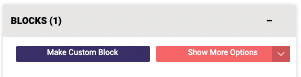
1. Click on the <mark style="color:blue;">**BLOCKS tab**</mark> on the left side control panel.

   <div align="left"><figure><img src="/files/68Sy8IGIv0pf3slIgZAs" alt=""><figcaption></figcaption></figure></div>
2. Click on the <mark style="color:blue;">**Make Custom Block**</mark> button.

   <div align="left"><figure><img src="/files/m996ukpqAnSaJrChXBS5" alt=""><figcaption></figcaption></figure></div>
3. The **Block Editor panel** will slide out and overtake your screen. My block is set to 12" x 6" finished, but it doesn't matter, the next steps will work for all sized blocks.
4. Set your grid guidelines by changing the number for the horizontal and vertical units.

   * Since I'm going to be creating a rectangular quilt block, I'll set my gridlines to 2 horizontal and 1 vertical unit.

   <div align="left"><figure><img src="/files/24SIXvkGbWB8tX7ME41p" alt=""><figcaption></figcaption></figure></div>

   <figure><img src="/files/H7CYxInRYi0Jvmo1Tbpy" alt=""><figcaption></figcaption></figure>
5. Click on the <mark style="color:blue;">**square shape**</mark> (<img src="/files/hy2ZsHmPdS74SBFprTv2" alt="" data-size="line">) from the central control panel.

   <figure><img src="/files/OLDxQfSYvWdVU68bOAHv" alt=""><figcaption></figcaption></figure>
6. Click on the <mark style="color:blue;">**Size to Fit**</mark> button (![](/files/APNNXCFLKcxDD4SB6ta8)) on the central, vertical toolbar.&#x20;

   <div align="left"><figure><img src="/files/disPl0YGVXmWft5HV6bA" alt=""><figcaption></figcaption></figure></div>
7. This will enlarge the square to fill the entire space of the rectangle.

   <figure><img src="/files/3vtPPun1Lp0nF3O4d3SC" alt=""><figcaption></figcaption></figure>
8. Click on the <mark style="color:blue;">**half square triangle shape**</mark> (<img src="/files/iPj39le0NWIilUW4GiLV" alt="" data-size="line">) from the central control panel. (It might camouflage in with the rectangle behind it. You can see that there is a square bounding box for the triangle).

   <figure><img src="/files/QiI5trZa93gHMWJjDpk7" alt=""><figcaption></figcaption></figure>
9. Click on the <mark style="color:blue;">**Link button**</mark> for a different fabric link (so that there are now 2 different fabrics being used). In this example, I am using Fabric Link B.

   <figure><img src="/files/4A3WaFIIf8y7qac4TTzT" alt=""><figcaption></figcaption></figure>
10. <mark style="color:blue;">**Move**</mark> the half square triangle piece into the bottom left corner of the rectangle. It should cover the square.

    <figure><img src="/files/CsXLvCi2otwYSlydrDxV" alt=""><figcaption></figcaption></figure>
11. Click on the <mark style="color:blue;">**Rotate button**</mark> (![](/files/dAVu3YUaYXrBpxkyHrgW)) on the central control panel so that it is in the correct orientation.

    <figure><img src="/files/bcDH2Tx66bWNwJBfdwmG" alt=""><figcaption></figcaption></figure>
12. You now have a **snowballed corner on a rectangle**.&#x20;

### <mark style="color:blue;">Alternative Snowballed Corner</mark>

Unlike the example in the first Help Guide, sometimes the snowballed corner does not extend to the full height or width of the rectangle or square.&#x20;

Follow these instructions for creating a snowballed corner that is not the full height or width.

1. Click on the <mark style="color:blue;">**BLOCKS tab**</mark> on the left side control panel.

   <div align="left"><figure><img src="/files/68Sy8IGIv0pf3slIgZAs" alt=""><figcaption></figcaption></figure></div>
2. Click on the <mark style="color:blue;">**Make Custom Block**</mark> button.

   <div align="left"><figure><img src="/files/m996ukpqAnSaJrChXBS5" alt=""><figcaption></figcaption></figure></div>
3. The **Block Editor panel** will slide out and overtake your screen. My block is set to 12" x 6" finished, but it doesn't matter, the next steps will work for all sized blocks.
4. Set your grid guidelines by changing the number for the horizontal and vertical units.

   * Since I'm going to be creating a rectangular quilt block with the snowballed corner being half the height and ¼ of the width, I'll set my gridlines to 4 horizontal and 2 vertical unit.

   <div align="left"><figure><img src="/files/llEURGrVe1Lw3bX2aYb2" alt=""><figcaption></figcaption></figure></div>

   <figure><img src="/files/INTu8S5Oq6jd5HBXZoNq" alt=""><figcaption></figcaption></figure>
5. Click on the <mark style="color:blue;">**square shape**</mark> (<img src="/files/hy2ZsHmPdS74SBFprTv2" alt="" data-size="line">) from the central control panel.

   <figure><img src="/files/vft9etQOpE8XMdmYkIRa" alt=""><figcaption></figcaption></figure>
6. Click on the <mark style="color:blue;">**Size to Fit**</mark> button (![](/files/APNNXCFLKcxDD4SB6ta8)) on the central, vertical toolbar.&#x20;

   <div align="left"><figure><img src="/files/disPl0YGVXmWft5HV6bA" alt=""><figcaption></figcaption></figure></div>
7. This will enlarge the square to fill the entire space of the rectangle.

   <figure><img src="/files/EgDc66AFx4UOxbc5qqfH" alt=""><figcaption></figcaption></figure>
8. Click on the <mark style="color:blue;">**half square triangle shape**</mark> (<img src="/files/iPj39le0NWIilUW4GiLV" alt="" data-size="line">) from the central control panel. (It might camouflage in with the rectangle behind it. You can see that there is a square bounding box for the triangle).

   <figure><img src="/files/GoeADtab2W3VFxOakmQ1" alt=""><figcaption></figcaption></figure>
9. Click on the <mark style="color:blue;">**Link button**</mark> for a different fabric link (so that there are now 2 different fabrics being used). In this example, I am using Fabric Link B.

   <figure><img src="/files/FwPCUszNbYd2oOj3P7Cl" alt=""><figcaption></figcaption></figure>
10. <mark style="color:blue;">**Move**</mark> the half square triangle piece into the top left corner of the rectangle. It should cover the square.

    <figure><img src="/files/f7Tj4Vjb2YwYPrTJT8aR" alt=""><figcaption></figcaption></figure>
11. Click on the <mark style="color:blue;">**Rotate button**</mark> (![](/files/dAVu3YUaYXrBpxkyHrgW)) on the central control panel so that it is in the correct orientation.

    <figure><img src="/files/iB4SX7xK5n2YE66VojIS" alt=""><figcaption></figcaption></figure>
12. You now have a **snowballed corner on a rectangle**.&#x20;

&#x20;   &#x20;

***

## <mark style="color:blue;">Sewing Construction Diagrams</mark>

### <mark style="color:blue;">1 at a Time - Snowball Method</mark>

*Coming soon*


---

# Agent Instructions: Querying This Documentation

If you need additional information that is not directly available in this page, you can query the documentation dynamically by asking a question.

Perform an HTTP GET request on the current page URL with the `ask` query parameter:

```
GET https://help.prequilt.com/prequilt-101/build-a-block-unit-for-the-fabric-calculator/rectangular-units/snowballed-corner.md?ask=<question>
```

The question should be specific, self-contained, and written in natural language.
The response will contain a direct answer to the question and relevant excerpts and sources from the documentation.

Use this mechanism when the answer is not explicitly present in the current page, you need clarification or additional context, or you want to retrieve related documentation sections.